


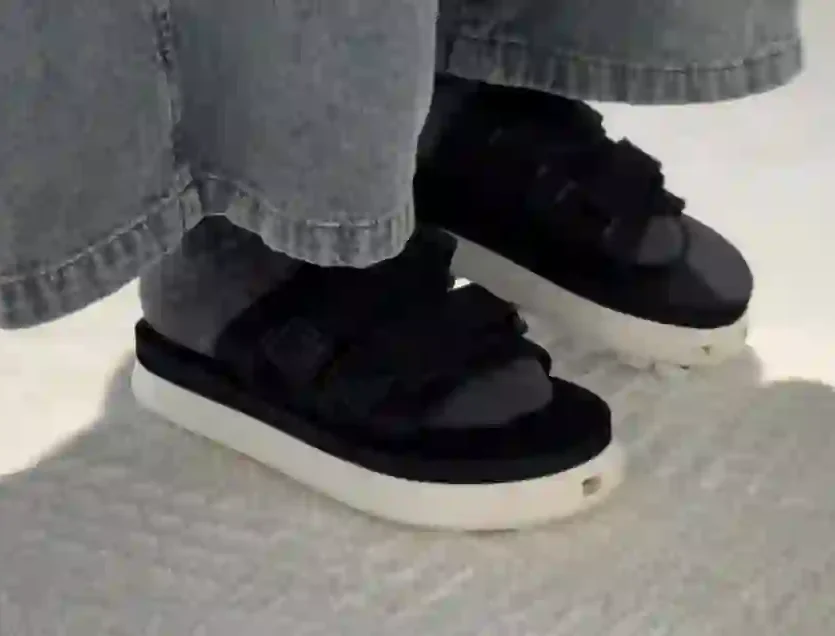
Bookshelf on Two Legs
From typing on keyboards and everyday walking to printers and AI systems assisting with work, the production of information in contemporary work and learning environments has gradually evolved into a highly standardized and mechanized set of actions. Starting from the bodily condition of everyday life, this work reconfigures the relationship between “input” and “output.” Random keystrokes generated through the act of walking with foot-operated keyboards are transformed into material for the generation of academic texts, thereby disrupting conventional writing mechanisms and the production processes of knowledge labor.
As an art graduate student, theoretical research and artistic practice are expected to support and intertwine with one another. However, for me, theoretical research often proves far more challenging than artistic creation, while technical operations appear comparatively accessible. Therefore, in the process of creation and research, I invite AI to serve as my speaking agent, positioning it as an observer and participant with multiple roles: it functions simultaneously as a hands-on “craft practitioner” and “technical engineer,” as an “artistic creator” engaged in sensory experimentation, and as a reflective “art critic” capable of analytical distance. Through this configuration, AI is drawn into an ongoing inquiry concerning a central question: does artistic creation precede discourse, or does discourse precede creation?
During this process, I also present to AI a series of questions that emerged while creating The Bookshelf on Two Legs, such as: “What exactly is art? Can transforming a keyboard into a pair of shoes be considered art?” “If a keyboard becomes an input device operated by stepping on it with one’s feet, does that still constitute art?” and “When the input source consists of random characters generated by audiences stepping on keyboard-shoes, which are then processed by AI according to prompts I designed, who should be considered the author of the resulting text—the audience, the AI, or myself?”
Through this non-intuitive mode of operation, The Bookshelf on Two Legs deliberately amplifies the presence of bodily labor within the process of input. Friction, delay, and uncertainty within bodily movement are brought to the foreground. The work attempts to reveal the alienation of language production in the age of AI, while simultaneously critiquing the formalized conventions of academic writing. In doing so, it invites renewed reflection on the nature of artistic creation, the role of authorship, and the participation of the body in processes of knowledge production.